
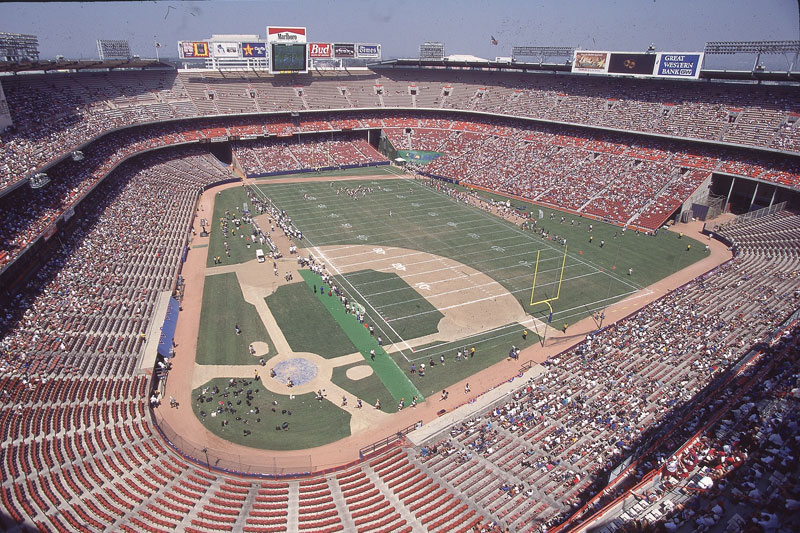
For 15 seasons, Anaheim Stadium served as home to the Los Angeles Rams, while continuing its long-standing role as the home of the Los Angeles Angels (MLB). Long before the Rams arrived, the California Angels had been playing there since 1966. After founding the franchise in 1960, owner Gene Autry set out to build a new stadium for his team. Modeled after Dodger Stadium, Anaheim Stadium officially opened on April 19, 1966. The original three-tier design seated 43,250 fans, extending from the right field foul pole around home plate to the left field foul pole. Escalators, elevators, and ramps provided access to its signature multi-colored seating. The stadium quickly earned the nickname “The Big A,” thanks to the towering A-frame scoreboard beyond the outfield wall.
After more than 30 years at the Los Angeles Memorial Coliseum, the Rams announced in the mid-1970s that they would relocate to Anaheim. The move was driven largely by the Coliseum’s refusal to add luxury suites. The team initially explored relocating to Dodger Stadium, but that proposal was rejected by the Dodgers. In December 1977, the city of Anaheim unveiled plans to expand Anaheim Stadium in an effort to attract the Rams. The renovation enclosed the previously open outfield, increasing capacity to 65,158 and creating a fully enclosed, three-tier seating bowl.
As part of the transformation, the original “Big A” scoreboard was relocated to the parking lot, and a new scoreboard was installed along the outfield façade. Additional upgrades included new executive and media suites and an enhanced sound system. Converting the stadium between baseball and football configurations was relatively straightforward, involving the temporary adding/removing of seating sections in right field. The Angels and Rams shared the stadium for 15 years, until declining attendance and limited premium seating options led owner Georgia Frontiere to relocate the team to St. Louis following the 1994 season.
Following the Rams’ departure, and damage sustained from an earthquake, Anaheim Stadium underwent a major transformation. After the 1996 season, extensive renovations began, including the removal of more than 20,000 outfield seats. These were replaced with bleachers, a new scoreboard, and additional fan amenities. The stadium’s iconic multi-colored seating was replaced with uniform green seats, and the exterior received a facelift with freshly painted concrete and ramps. A new entry plaza was also constructed, highlighted by two oversized Angel hats.
Renamed Edison International Field in 1997, the revamped stadium reopened on April 1, 1998, with a reduced seating capacity of 45,050. In 2003, it was renamed Angel Stadium, a name it continues to carry today as a modernized yet historic home of baseball in Southern California.